Hi, my name is Rayyan, and I am a MArch 1 student, currently part of the Continuity atelier. I completed my undergraduate degree in architecture in India, where I gained experience working in practice across a range of projects, from small-scale residential work to urban-scale master planning. Alongside this, I also worked on independent professional projects, which helped me build confidence in both design thinking and technical delivery.
Through both university study and professional practice, I have developed a strong interest in adaptive reuse and context-led design. I am particularly interested in how architecture can respect heritage and craft while creating meaningful, people-centred spaces for the future.
I am excited to engage with the Unitarian church on this live project. Learning about their values of openness and community has been incredibly valuable, and I look forward to contributing thoughtfully to a design that supports their long-term vision.
Posted 19 Feb 2026 01:00
Session 9: The “Everyone Has an Opinion” Session
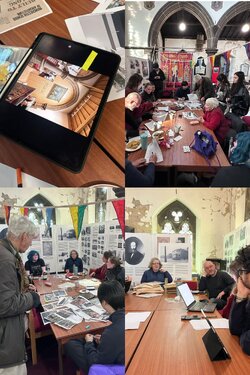
This session was where things got real. No more guessing, no more “this might work”. We finally took our ideas to Brookfield Unitarian Church and let the community tell us what they actually think. Slightly terrifying, but mostly very useful.
We set things up with our plans, precedent images, and our carefully prepared (and rehearsed) explanation of the project. The idea was simple: keep it open, let people react, and see where the conversation goes. And it definitely went somewhere… in about ten different directions at once.
A big theme that quickly emerged was the classic open vs closed debate. Some people loved the idea of flexible, open spaces, while others immediately asked for partitions, dividers, and ways to split things up. But (of course) no one wanted to completely lose connection. People still wanted to see and hear what’s happening in the main hall, especially from the kitchen. So essentially: divide the space, but don’t actually divide it. Simple.
Accessibility also came up, and this was a bit of a reality check. While the church is clearly inclusive in its values, the building itself doesn’t fully support that. A wheelchair user pointed out that although there is a movable ramp to come inside, the movement inside is still quite limited.
Then came the very real, very practical concerns. Heating, for example, takes over three hours (yes, three hours), which explains a lot. Naturally, people suggested breaking the space into smaller sections to make it more efficient. Storage also became a surprisingly big topic, like everything from general storage to “where do we keep the lawn mower?” made an appearance. Design meets reality.
The kitchen turned out to be more important than expected. Not because of cooking (tea and coffee seem to be the main event), but because it’s a social space. People want to stay connected while using it. Hence, ideas like a serving hatch, seating nearby, and maintaining visibility into the main hall.
We also briefly touched on bigger ideas like temporary structures and external additions… which were quickly brought back down to earth by planning rules and costs. A gentle reminder that architecture does, in fact, have limits.
All in all, a slightly chaotic, very honest, and genuinely insightful session. Lots of opinions, a few contradictions, but exactly what we needed.